ME Experience

  • Work
  • Services
  • Team
  • Partnerships
  • Blog
  • News & Social
  • Contact

Start building a better culture by doing this one thing consistently this year

May 8, 2018

Start building a better culture by doing this one thing consistently this year

I recently read a story about Sheldon Yellen, the CEO of BELFOR Holdings, Inc, a global disaster relief and property restoration company, who personally writes a birthday card to everyone one of Belfor’s 7,400 employees every year.

That’s some effort.

To put that into context that works out, on average, to be 37 cards every working day of the year.

Now, many CEOs or other leaders may see this as a frivolous activity or not a good use of their time. But, Mr Yellen would disagree.

He believes the practice, which he started 32 years ago, has helped his firm communicate better and create a culture of compassion as well as acting as a reminder that a company’s greatest asset is it’s people.

Whilst it would be really easy for Mr Yellen to outsource the writing of these cards to his team or to a hybrid hand-written note/digital supplier or to even try and automate the process with a slick bit of technology.

He hasn’t.

He chooses to continue to write thousands of cards every year, fitting the writing of the cards into his busy schedule.

Why is that?

I believe that Mr Yellen understands the enduring power, value and benefits that exist within the writing, sending and receiving of hand-written cards.

They include things like:

  • Personal, handwritten cards and notes stand out and grow rarer by the day.
  • There’s a certain joy and excitement that comes with receiving an envelope in the mail with your name on it.
  • Handwritten cards and notes don’t suffer from bounce rates or open rates. I mean, when was the last time that you didn’t open a hand-written card or letter that was addressed to you?
  • As a result, it’s almost 100-percent guaranteed that the receiver will feel great.
  • Handwritten cards show people that we are willing to spend time on them, we care about them and we cared enough about them to physically write something for them.
  • The process of physically writing something requires thought and the deliberate choice of words. You can’t easily erase something. That takes time and effort.
  • Cards are physically received, opened and then displayed. They can become conversation starters and also allow us to ‘surround’ ourselves with people that care for us.

I believe Mr Yellen’s experience offers lessons for other leaders and organizations that want to both build a better culture within their organization and better relationships with their customers.

Now, I am not suggesting that CEOs and leaders should start sending nearly seven and a half thousand cards every year, as Sheldon Yellen does. No, not at all. It took him 32 years to build up that impressive habit.

Rather, I would suggest that CEOs and leaders consider sending more hand-written cards to their employees and their customers over the coming year to acknowledge and celebrate them on their birthdays, their achievements, their work anniversaries, a promotion, a success or some other meaningful event. Just to show them that they are cared for, recognized and valued. I would also suggest that they start small and build up from there just like you would do if you were adopting and developing any other new habit.

Just imagine the impact you would have had if, by this time next year, you had consistently sent out 3, 4 or more hand-written cards every day over the course of the next year to your employees, customers, partners and suppliers.

Adrian Swinscoe
Filed Under: Uncategorized

April 5, 2018

Why do US brands outperform the UK on CX?

I was taught from a very young age that success is a planned event. It doesn’t just happen. You have to make it happen through meticulous planning and hard work.

All the statistics show that the USA leads the way in Customer Experience (CX). I am not talking about the ‘Have a nice day’ stuff. I am talking about the scientific application of language and behaviours which drive a considerable ROI for the organisations that get it right.

So, what do US brands do better than us?

The following are some elements which these successful organisations have in common:

  • They are structured around the customer
  • Focused on employee engagement
  • Get the basics right
  • Understand resolution management

Importantly, US brands are very focused on how employees interact with customers, the types of behaviours they use and the service levels they aspire to. Their target for a great experience is far higher than companies in the UK.

You may have read my recent article on Breaking down Silos within organisations. Successful CX US brands do just that – they are structured around the needs of the customer rather than departments or functions. This gives them considerable competitive advantage when going to market and managing the experience delivery.

Enhancing Employee Engagement

Employee engagement plays a critical role in this and is something, sadly, too many UK brands have not looked to optimise.

One particular hotel brand which is very successful and sits high on the CX rankings has worked hard to create a sense of pride within the organisation by looking at jobs titles. It doesn’t call people ‘staff’ or ‘employees’ – it calls them ‘talent’. It doesn’t refer to ‘maids’ or ‘house keepers’ but ‘stylists’. You may well say that this wouldn’t work in the UK and is all a bit ‘out there’ but please don’t lose sight of the principle here: these organisations care about their teams and will go to significant lengths to make them feel great about themselves, so they, in turn, will make the effort to make their customers feel great.

As Richard Branson said: ‘How you treat your people is how they will treat the customer’.  We have found four overarching principles which are driving great CX success in US organisations, and these are:

  • They aspire to excellence, driven by informed and CX motivated senior leadership teams
  • They have the right culture and understand how to engage employees to ensure they in turn deliver outstanding Customers Experiences
  • They are ruthless in the execution. They don’t have a ‘travel hopefully’ strategy – they are totally customer focused in all they do and every decision they make
  • They are very aware, driven by and focused on the financial outcomes of great CX and the value it adds to the brands

How does your organisation stack up on these? If you would like to discuss any of the points raised in this article get in touch we would love to hear from you.

Steve Dudley

Filed Under: Customer Experience, Uncategorized

March 6, 2018

Are Silos Stopping your Organisation Deliver Great CX?

Joined up Customer Experiences that are differentiated and relevant are proven drivers of business growth.

Tesco, Asos and Lidl are just a few of the many brands who are currently enjoying success as a result of new Customer Experience (CX) strategies.

Breaking Down the Silos

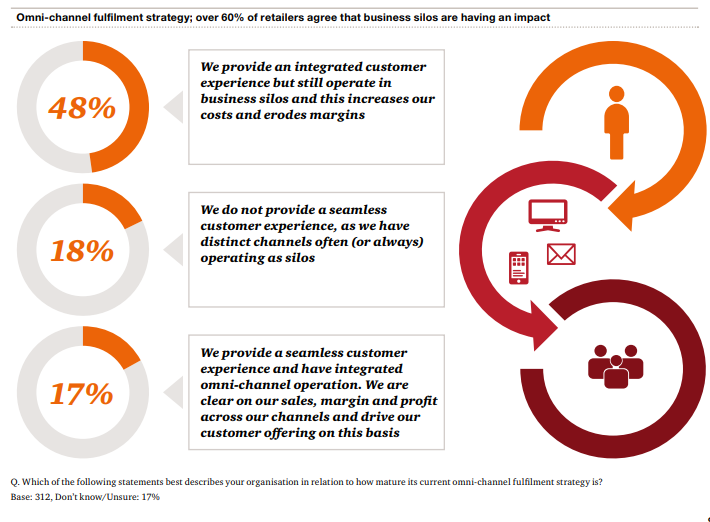
One of the key factors which have proven successful for all these organisations is the breaking down of the many silos which previously existed. Traditionally many large companies, with the way they have grown and as a result of constant restructures, have developed a ‘silo mentality’. These silos prevent teams being able to focus on the end to end Customer Journey. They also increase bureaucracy, create differing work practices and cultures – all of which are barriers to teams being able to see and understand the full CX picture, the role they play and, most importantly, how they can help to enhance the overall Customer Experience.

In fact PwC and SAP jointly commissioned a research study, surveying over 300 retailers and 2,100 consumers across six countries in Europe (the United Kingdom, the Netherlands, Germany, Italy, France and Spain) to explore consumer and retailer perspectives on the integrated shopping experience.  Their image below shows their findings with over 60% of retailers agreeing business silos are having an impact on their omni-channel fulfilment strategy.

How to make a change

Success in CX comes where change doesn’t start from an overhaul or restructure, which can create more complexity. It begins with a focus on how people work together, what the needs of customers are, and understanding the culture of the different functions. It is critical to get everyone on the same page, to understand what the overall CX Vision is and the role that each individual has to play in helping to deliver that Vision.

Enhancing Internal Customer Experience

From our experience with many major brands, where you can get different departments to work closely together, to understand one another, to understand each other’s goals, aims and challenges. This understanding can make a significant impact on their ability, and indeed willing, to work together to improve the overall CX.

One of the main benefits of breaking down the silos is that it opens up understanding and opportunities for differing departments to provide each other with an enhanced internal Customer Experience. After all, it’s a fact, the only way to deliver great external Customer Experience is by delivering a great internal Customer Experience.

So, if you need help breaking down the silos in your organisation get in touch we would love to hear from you.

Steve Dudley

Filed Under: Customer Experience

December 20, 2017

7 Key Principles to Improve your Customer Experience

When I tell people that I work as a Customer Experience Consultant, most of them assume it’s just a fancy title for a customer service agent, immediately envisaging a call centre with a headset.

Whilst Customer Experience does include customer service it also encompasses the whole end-to-end experience of a customer’s journey, including all the people they interact with, all the back-end processes they go through and all the technology that enables successful delivery of the service.

Improving Customer Experience doesn’t have to be complex, what is really needed is to go back to basics.

It is simply putting the customer first and then setting up and aligning your organisation to fit around them so that the whole of the customers’ experience is consistent, connected, memorable and hassle-free.

Unfortunately, a lot of companies have already been built the other way around. So where do you start?

1 Talk to your customers

It sounds obvious but you would be surprised how many organisations are so internally focused or competitor driven they have completely forgotten the customer. Often organisations spend so much time talking amongst themselves in meetings, creating ideas and processes they think the customer would like without actually asking them. Taking the time to involve your customers and gathering their feedback is hugely beneficial, saving time and money, in the long run.  Looking at the same processes from a customer’s perspective often sheds a very different light on something you thought was perfect.

2 Align & Embed 

Tempkins 2016 reports show only 4% of organisations have CX (Customer Experience) embedded as an integral part of their company culture. Key to getting this right is to align both your Business and Brand Strategy with your customer strategy but more importantly is to ensure it is embedded effectively.  When cascading this information throughout the organisation, it needs to be in a simple, memorable format that is relatable to each member of staff and their specific job role so they can align their daily decisions and actions with the strategic direction of the company.   All too often staff are handed a company vision or mission with no understanding of how this relates to them or the role they play in achieving this.

3 Breakdown silos

Simply put, people working together will achieve more.  It is far easier to solve issues, drive change and improve communication when there is cross departmental collaboration.  This way of working also ensures shared ownership and accountability of the customer’s journey instead of individual channels of interactions.  This helps to stop issues getting lost and passed from department to department causing frustration to the customer.

4 Legacy systems vs New Technology

Many organisations fear changing legacy systems as it often seems too complex or expensive ie they have already invested a huge amount on upgrades which have had little or no impact on the bottom line.  The key lesson here is to make sure the technology is fit for purpose. You don’t need to use the latest technology but it must be the right technology to best serve your customers.  All key stakeholders, including the customer, must be involved in the decision-making process as there is no point in upgrading something if it has no impact on the customer or is not embedded effectively. This is often challenging in the “I just want it done” culture within some organisations.

Louise Downe, Director of Design & Standards Government Digital Service, explained this nicely in a presentation recently at the Service Design in Government conference saying, ‘’It should be viewed as “problem caring vs problem-solving’’ ie you will never be done fixing things and the world won’t stop changing, so you just need to ensure you balance delivering actual things with changes that are also scalable and sustainable.

5 Empower your people

Being at the forefront of interactions with customers, your employees are your most important asset.  Equipping your staff with all the training they need to fulfil their role is crucial, as is training them on customer centricity to help them understand what the overall customer experience is and the part they play in building a customer-centric culture.  Let them actively own issues and give them the power to solve customer problems without always having to get authorisation from managers.

By involving staff and asking their opinions they are more likely to embrace change and be on board to help you achieve your goals. They are likely to have many ideas and solutions to resolve existing customer issues, they have just never been asked.

6 Get rid of bureaucracy and unnecessary processes

Don’t get me wrong; processes, structure and guidelines are hugely important and are normally the backbone to every business. However, what I can’t stand is doing something just for the sake of doing something, it must have an impact.

Question why you are doing something if it doesn’t involve improving things for your customer (and is not regulatory required) Stop doing it.

Very often if you ask someone why they are doing something you will normally get the response, “it’s always been done like this” or “we were just told to do this”.  This again goes back to my point on engagement, if people don’t understand why they are doing something or the bigger picture they will never be able to spot issues, improve things or work autonomously when needed.

7 Spend time standing back

It sounds simple, right? Most of us know we should be doing it, but normally we are so busy in the day to day firefighting tasks we often have little time to stand back and look at the bigger picture.   Completing an exercise of mapping out your customer’s journey will allow you to empathise and see your business through your customer’s eyes, highlight numerous opportunities to improve their experience and add value to your business.

About the author: Amy Brustia is a Certified Customer Experience Professional (CCXP) at Multifarious Experience.

At Multifarious we are passionate about helping ambitious organisations grow and be ahead of their competition by transforming their customer experience and by building a truly customer-centric culture. If you’re interested in taking your customer experience to the next level, get in touch.


Filed Under: Uncategorized

April 7, 2017

3 steps to corporate empathy

Being customer-centric is more than building the right design strategy, it means embedding empathy.

The question on everyone’s lips is: “How do you create better experiences for your customers?” There’s much talk of digital transformation and designing customer experiences. However, when you put technology in the driver’s seat, the customer is left in the passenger seat, and technically you cannot “design” an experience. You can, however, “design” your organisation, so when an interaction with a customer happens—the experience will be a positive one.

So, how do you make your organisation more customer-centric? The key is a two-pronged approach. The first is having a human-centric development process.

Customer-centric organisations have evolved their product development process to systematically include the human aspect alongside technology and commerce at every step. It’s not just about having an established customer experience design budget and running some projects here and there. It’s about using customer experience design strategically, on every project, and having customer experience present at board level. But this topic is well discussed, I want to focus more on the second, building your corporate empathy.

Equipping your employees with the knowledge and methods of customer understanding can be a real eye-opener. Many employees see that technology and marketing alone don’t cut it in the service economy and embrace new methods enthusiastically. This complements the development process and makes happier employees.

Three Steps To Building Corporate Empathy

The first step is building empathy for the end-user of your product, service, or experience. This is about working face to face with your customers. Forget focus groups—go into their homes! And make sure you prototype and iterate, fast. Whether it’s prototyping digital products or life-size cardboard pharmacies, don’t be afraid to make and build.

One such case study is for Finavia, Finland’s airport operator. Helsinki Airport is a popular transit airport, with around five million transit passengers a year. Finavia wanted to support Helsinki Airport in becoming the leading transfer airport of Northern Europe. They launched the globally unique TravelLab project, which involved service concepts being tested during the transfer experience.

They tested 12 different kinds of new service prototypes chosen from 200 improvement ideas gathered from passengers. They included pop-up yoga classes “YogaGate” and midsummer (a popular Finnish holiday) celebrations, as well as technical services, such as digital boards on the gate buses providing information on what to do at the airport. All were live prototypes, quickly set up and quickly changed if they weren’t working. Nine hundred passengers took part across 75 days.

During the process, TravelLab invited passengers to take an active part in designing better transfer experiences. What was really happening was an agile, human-centric process of service design and prototyping, and a large corporation openly taking part in co-creation.

The project was a huge success. It won two awards: first prize in the prestigious Best of the Year (Vuoden Huiput) design award in Finland and the global Service Design Award in New York from the leading institution for expertise in service design. Also, Helsinki Airport won an award as the best airport in Northern Europe, based on Skytrax’s international airport survey.

The second step is to educate your project teams. Build a training structure for your teams, get them to partake in empathetic activities such as role playing, and create ownership and skills. Hire a third party to help you with this if needed, or organise it with your internal training and development teams if they are equipped to do so.

The third step is for everyone. All employees must live the culture. I often say: “Eat your own dog food.” What do I mean by this? Well, if you work for a large telco, you never really have to experience what it’s like to get a phone contract or look at and understand your phone bill, you get a free phone and the bill is automatically paid. How can you understand your customers’ concerns if you don’t do what they do? You must experience what your customers experience. But also you must have empathy for each other. Organise cross-silo activities and events. Get to know each other and get out of your comfort zone!

When you’ve climbed these three steps, customer understanding and empathy will start to get into your company’s DNA. You will build sound understanding of customer experience—it will permeate from the leaders down and to the experience customers have with you. Positively.

Markus Hohl

Filed Under: Uncategorized

  • 1
  • 2
  • Next Page »

Want to know more?
Have a Coffee with Hassan

+44 (0) 744 711 2068
+44 (0) 207 096 0546
Email: [email protected]
Let’s talk about how we can help you build a better customer experience.
GET IN TOUCH

Call us: +44 744 711 2068

© Copyright 2026 ME
 | London
| Saudi Arabia

BACK TO THE TOP

Privacy Policy Cookie Policy Terms of Website Use Acceptable Use Policy General Terms & Conditions Creating a World Class Buying Experience
This website uses cookies to improve your experience. Accept Read More
Cookies Policy