ME Experience

  • Work
  • Services
  • Team
  • Partnerships
  • Blog
  • News & Social
  • Contact

Keys to Arabic Web Design

October 9, 2016

Keys to Arabic Web Design

Arabic web design UX tips Web design

Arabic is the mother tongue of one of the fastest-growing sectors of internet users, with a 30-fold rise between 2000 and 2012 − and 41% of Saudis on Twitter, the highest rate in the world – so why are fewer than 1% of web pages in Arabic?

The answer is more technical than you might think. Although a kind of block printing called tarish developed in Egypt in the 9th-10th centuries, Arabic was not used with movable type on a large scale until after Napoleon brought printing presses to Egypt. Arabic script is far better adapted for hand lettering than separate metal types, as most letters change shape depending on the letters before or after them; some combinations can even be written vertically.

We needed to spend weeks making Arabic typography fully functional across all devices, given the poor support for Arabic fonts online

Challenges of Arabic Typesetting
0e882358123345b19e2a01492e695142
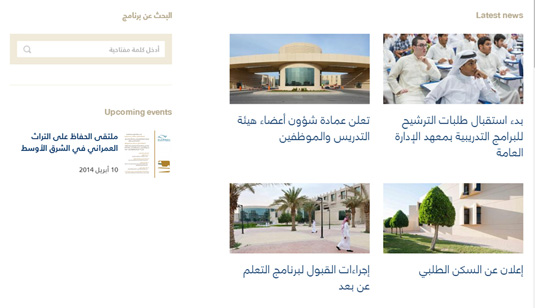
Arabic website visitors will be used to reading right to left

Electronic media solved most of these problems, since Arabic fonts are designed with algorithms that alter letters depending on their place in the word. But the number of Arabic fonts available is still minimal compared to Latin fonts, and even fewer are supported online, leading to websites that often look outdated and clash with their company image.

Over half of all pages on the Internet are currently in English. However, Arabic grew more quickly than any other online language (over 2,500%) from 2001 to 2011, proving that Arabic speakers are making huge steps to catch up – sometimes in defiance of regimes that limit internet use. The political role of Arabic online is considerable: at least two regimes, those of Egypt and Tunisia, disintegrated due to the direct impact of social media.

Going mobile

Above all, smartphones are leading a sea change in web design, as they are now the principal means of accessing the internet for many people in towns and cities, and often the only way to get online in rural areas. Recent news stories of Syrian refugees using smartphones confirm their usefulness in our globalised world, enabling families to stay in contact even in conflict zones.

Mostly, though, we use internet for work, communication or leisure, wherever we are in the world. According to our research, 30-40 % of internet users in the Middle East surf the net regularly on their smartphone or tablet, and that’s a figure that is only set to grow. In our redesign of the University of Dammam’s bilingual Arabic-English website, we made the site fully mobile-friendly and flow intuitively like an app, as it was clear that most current and potential students would be using a mobile or tablet to access information on the site.

Switching to RTL

So what are the main obstacles to Arabic web design? Since Arabic reads right to left (RTL), Arabic versions of existing websites need to be completely flipped horizontally. Image selection is crucial: pictures need to be chosen specifically for LTR and RTL interfaces, as simply making a mirror image of them will look strange – and turn any writing in them to gibberish.

Most of all, Arabic websites that also incorporate European languages present a real challenge, as the text will be switching back and forth between RTL and LTR. A platform such as Drupal, which supports international and localised websites and even contains ready-made translation files for most standard strings, is ideal.

HTML Prototypes
e66f8e7ae258471ea2748dca9c63ab2a
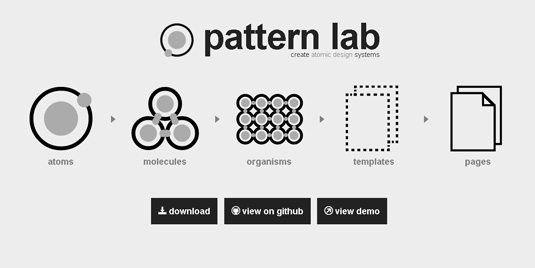
Patternlab is based on creating pages via atoms, molecules, organisms and templates

When building an Arabic language website it’s helpful to start with an HTML prototype.

When we were commissioned to redesign the University of Dammam’s multilingual website, working with the web design company Bright Lemon, who designed the web architecture and built the back end of the site, we chose to use the HMTL software Patternlab. Patternlab uses a more organic method of creating websites by way of ‘atoms’, ‘molecules’, ‘organisms’, templates and pages, rather than the traditional wireframe model.

HTML prototypes enables the developer to create a clickable workflow that can be altered easily, and therefore cheaply. This in turn allows all the clients to see an overall view from the outset. Furthermore, if the HTML or CSS is of a high enough quality it can be used throughout Alpha, Beta and Production stages.
fb1a0b5583d64619aa938653d3421c2c
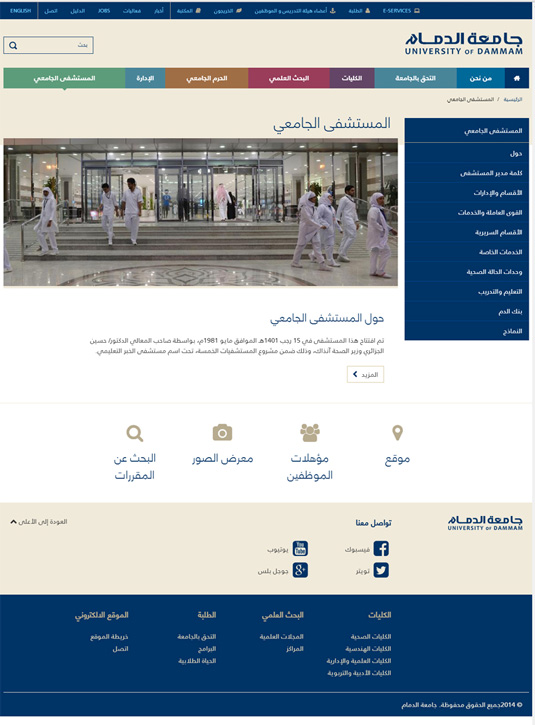
There are far fewer Arabic web fonts available than Latin fonts

Arabic Aesthetics in the Digital Era

Apart from the technical aspects of structuring an Arabic language website, the aesthetic experience is crucial. It can be tricky to make an Arabic version of an English site look the same across both formats, yet it is essential to brand coherence. For the University of Dammam site, we spent weeks making sure that the Arabic typography worked across all devices.

The Arabic script has provided us with a tremendously rich artistic legacy, from the boldness of early Kufic to the splendour of Ottoman monumental scripts. With each new evolution, Arabic writing has been adapted to suit new materials and mediums, from papyrus to paper, ceramics to textiles, metalwork to mosaic. Online typography is merely the latest in a long line of mediums in which we’re sure Arabic will triumph in too, using these keys to open the way.

Filed Under: Uncategorized

May 10, 2016

New Retail Sales Workshop Launched

We are delighted to launch our highly acclaimed sales training,Creating a World Class Buying Experience, as a standalone one day workshop.

Aimed at retailers who want to train their sales people how to provide an exceptional buying experience for their customers so their business really stands out from their competitors.

Based on our unique, proven approach we focus on the ‘relationship’ and not just the ‘sale’. We show delegates how, through the delivery of a great buying experience, to get customers to WANT to buy from them, rather than them having to do the selling.

Highlights of this riveting one day interactive workshop include: the psychology of buying, understanding a customer’s decision process, ways to engage and connect, tailoring product presentation to create desire, handling objections, recognising buying signals and a natural ‘close’.

Steve Dudley, course director says: ‘Research shows more than 50% of customers will spend more on products and services if the overall experience is great and memorable.  This workshop gives sales teams the skills and confidence to deliver a superior buying experience, helping them to understand both the ‘why’ and the ‘how’, creating standout and differentiation from the competition and increasing customer delight and sales.’

Filed Under: Uncategorized

May 9, 2016

Pointers for CEOs to Ensure a Sustainable CX Strategy

Enlightened CEOs embrace Customer Experience (CX) as the new competitive battleground and the route to profitable differentiation in organisations. However, delivering a sustainable Customer Experience strategy is not without its challenges. Here are some pointers to help embed an effective CX strategy from the outset:

Go large or go home

Conventional wisdom calls for piloting changes on a limited basis which if successful are rolled out more broadly. Whilst this works for individual elements or small tweaks, it does not work for implementing an effective Customer Experience strategy. You need to think in terms of Change Management that embraces the whole organisation and have the Board and senior management fully committed, leading by example to be able to achieve results fast.

Also it is useful to focus on quick wins early in your programme implementation, as we find that when staff see results early on in the programme they buy in wholeheartedly.

A holistic approach

Adopt a holistic approach when looking at the customer journey and the stakeholders involved. Understanding the functional relation between parts and the whole is important for managing the spectrum of interactions that combine to impact on Customer Experience.

Often the temptation is to focus training and incentives on front end staff, when it is internal service providers like logistics, IT or accounts that are key in providing the right support for customer facing staff. These internal service providers are as important enablers in ensuring front line staff can deliver an excellent Customer Experience.

Continual refinement

Customer expectations are dynamic and evolving, and so too will your CX strategy. Think of it as an iterative process, that has a beginning, middle but no end. It will be evolved and measured, even changed or paused if necessary, never stopped. And each iteration will realise learning and refinement.

In terms of measurement try not to just track traditional metrics like Net Promoter Scores or Share of Wallet, whilst they are useful, they are lagging indicators. Look at the number of new value adding service ideas in your organisation, the levels of staff engagement, voice of customer studies and customer’s reviews.

In closing… once you have an integrated, fully embedded Customer Experience programme that is producing results …the challenge is then how to take it to the next level.

Filed Under: Uncategorized

February 25, 2016

10 Commandments for a Successful CX Strategy

1 Leadership

Leaders of the organisation must set the standard, not just ‘talk the talk’ but also ‘walk the walk’. Demonstrate through their actions, that they believe in CX and then encourage the right behaviours by demonstrating them on a daily basis, every single day.

2 Ownership

Management at all levels must take ownership for their respective areas and push on with actions that will develop the CX with their teams. This is not about waiting to be told what to do, this is about taking the initiative and driving out actions – making things happen. Some stuff will work, some won’t. It doesn’t matter, be brave and experiment. If you are starting with your Customer in mind, that’s all that matters.

3 Accountability

People at all levels of the business need to be held accountable. There should be consequences (good & bad) for demonstrating the right behaviours and language, and also for not performing in the right way. No-one should be allowed to ‘opt out’. People opting out and deciding this is not for them will seriously damage an organisation’s ability to max out on the opportunity delivering a great CX offers.

4 Empowerment

Staff at all levels need to be empowered to make the right decisions for their Customers. In any situation, there is only one question which should be asked: “ What is the right decision for the Customer”.

As Richard Branson says ‘ ask me for forgiveness not for permission’

You may wish to set some boundaries/guidelines, but your people must feel empowered to deliver a great CX for your Customers.

5 Support

Initially your team may not find this easy to grasp. They have many (potentially bad) habits which will take a while to eradicate. Support from the leadership team will be key. Ask them what support they need (collectively & individually) to move this on, then provide that support and work with them to help them make progress.

6 Momentum

It is critical that you start to do some ‘stuff’ quickly and that you start to build some momentum. Once started, activity (different ‘stuff’) should be driven/encouraged/made to happen every week/month/quarter until momentum is developed. This is very much like pushing the proverbial snowball up the hill, a great deal of effort will be required initially until you reach the top and push it over the crest, and then it will run & run.

7 Communication

Keep telling everyone what is going on. Weekly/Fortnightly/Monthly comms. (newsletter, emails) are essential to keep everyone up to speed with what is happening across the business.

Share success, catch people doing things right, share Best Practice, ideas, good news – anything related to Customers & CX.

This should be positive, upbeat and fun – and have lots in it about people! Certainly initially, CX needs to be kept top of mind, until it is embedded and becomes cultural (how we do things around here). Comms are the way to drive this.

8 Recognition

Praise people when they get it right, when they demonstrate great CX, when you get positive feedback, Customer compliments etc. This doesn’t need to be loads of ££££, this is about fun, making people feel good, feel valued and encouraging the right language and behaviours.

9 Measurement

You have to have a starting point (where are we now? How well are we doing?). Not a subjective starting point, but very much an objective starting point. Suggestion: Spend i.e. a month asking Customers to rate you on a 0-10 basis. Use these scores to determine your Net Promoter Score and you have starting point. Through regular feedback , you can then measure your NPS and see how you are tracking.

NB – you MUST measure, otherwise how do you know that what you are doing is working and how well you are progressing?

10 Fun

Quite simply this is critical! Initially all this CX stuff can all seem a tad ‘intense’. Help your team to want to do it – by making if fun!

Happy staff = happy Customers.

Take time (MAKE time!!) for you and your team to have fun and enjoy the CX work/progress you are making.

Filed Under: Uncategorized

February 23, 2016

Delivering Great Customer Experience

You either get it …or you don’t

I recently purchased a new car (from a certain German brand) and whilst their cars and their technology are amazing, it is so sad to see that, when it comes to people, they just don’t get it.

Delivering great Customer Experience is not about throwing money at it and introducing processes which employees have to follow rigorously (yes, process do have a key role to play, but only on the back of the right ethos and when used with employees who get it, and work in a culture where the organisation genuinely understands it’s Customers).

In my recent car buying experience, it was all about the product, the process and the sale. There was very little, if any, thought given to how the Customer was being made to feel at each stage of the sale.

I was told the car would be delivered to the dealership on ‘X’ day and would be ready for collection a few days later. As ‘X’ day approaches, how is the Customer feeling? Excited, curious, eager. Yes, and much more. So when ‘X’ day arrives and there is no call to say the car has arrived (or not arrived), how then does this make the Customer feel? And when, at ‘X’ + 1 days, there is still no call, where do the Customer’s emotions go then?

At ‘X’ + 2, I made the call to see where my car was. ‘Oh, no one has told me it has arrived’ was the response from the salesman I was dealing with. ‘I will go and check and come back to you’. Ownership? Empathy? In tune with the Customer’s emotions? I think not.

The story continued in this vain and I will spare you the detail and take you to collection day . (which was some three weeks after it arrived at the dealership, but let’s not even go there!!!)

The day before collection. Again, how is the Customer feeling? You will be collecting your shiny new car in less than 24 hours. This is a big moment. You did your research, you thought about it, you planned it, you placed your order, you waited for the car to come in, you waited for the car to be ready and finally, it is going to happen. You are going to go and collect your lovely new car and drive it home.

If you think about this from the Customer’s perspective, this should be all about them. All about how to make the event a great one for them, one they will enjoy, cherish and remember forever. One which will mean they will want to come back to your organisation time & time again to re-purchase. One they will tell all their friends & family about, bringing new, additional business to your company.

This is the exact email I received to arrange collection of my car:

Hi Steve,

I just wanted to plan my weekend as I am only in on Saturday and have some appointments already. Would you be available at 9am to collect tomorrow? Please let me know.

Whose agenda are we on here? Have we thought about the significance of this event for the Customer?

How did that make me feel? Valued? Cared about? Important? I think not.

These are the emotions which Customers want (and need) to feel. Great organisations will understand this and will plan how to make their Customers feel like this at each stage of the experience. That is what drives loyalty and keeps Customers coming back, time and time again.

Where do you think I might buy my next car?

Filed Under: Uncategorized

  • « Previous Page
  • 1
  • 2
  • 3
  • Next Page »

Want to know more?
Have a Coffee with Hassan

+44 (0) 744 711 2068
+44 (0) 207 096 0546
Email: [email protected]
Let’s talk about how we can help you build a better customer experience.
GET IN TOUCH

Call us: +44 744 711 2068

© Copyright 2026 ME
 | London
| Saudi Arabia

BACK TO THE TOP

Privacy Policy Cookie Policy Terms of Website Use Acceptable Use Policy General Terms & Conditions Creating a World Class Buying Experience
This website uses cookies to improve your experience. Accept Read More
Cookies Policy